
This article offers a unique insight into the courts of Devon and Cornwall and reveals how life on the edge can lead to court.
Poverty is an invisible presence behind the courtroom doors of Devon and Cornwall. From unpaid fines and mounting debt to homelessness and inability to afford legal representation, we are seeing the ever-growing consequences of financial hardship.
The story of poverty
When people think about courts, they think about crime, punishment and justice. But, look a little closer and another story emerges.
Financial insecurity
For many people, their journey through the justice system does not begin with a single incident. It begins much earlier, when, for instance, they might have left care at 18, alone and facing unemployment or low-paid employment. As a result, this can lead to:
- Financial insecurity
- Unstable housing
- Debt
- Struggling to access mental health support or rehabilitation services
Troubling picture
Our experience paints a troubling picture of some people caught in a cycle of hardship, often unable to get help until their circumstances have escalated to the point where they find themselves in the magistrates’ court. Frequently, this is the case for both defendants and victims.
When a fine becomes another financial crisis
Consider someone summoned to court because they have failed to pay a fine. On paper, it may appear to be a straightforward matter of unpaid money. However, behind that case could be a person struggling to meet the basic needs of their family.
The cost of public transport
Even getting to court can become a financial burden. For example, our frontline teams often need to help with train or bus fares when people can’t get home after court, especially with the long distances in Cornwall.
Expensive journey across many miles in a bus
We recently highlighted the case of a man whose journey to court involved three bus journeys, with the cost of travel taking money away from his already stretched family budget. It raises an important question: are we looking at the circumstances behind the unpaid fine, or just the failure to pay it?
The hidden cost of accessing justice
Poverty also affects people’s ability to navigate the legal system itself. For instance, individuals forced to represent themselves find the process confusing. Sadly, our contract for support through the family courts has come to an end. Unfortunately, without the money to pay for a solicitor, more people will now be left trying to understand complicated paperwork.
A regional problem
Noticeably, isolation in rural areas makes matters worse. Ultimately, long distances, limited public transport and fewer accessible services can mean that getting advice or attending appointments becomes an impossible expense.
Rural poverty in Cornwall
Cornwall Council published some statistics about rural poverty in Cornwall in 2025:
Significantly, one of the primary drivers of deprivation in Cornwall is low incomes.
Rural poverty in Devon
To summarise, the Devon Community Foundation has explained rural poverty in Devon here. The Indices of Multiple Deprivation reveals the concentrations of higher deprivation across Devon and Cornwall.
Pressures facing rural communities
Devon County Council’s 2024 poverty assessment highlighted the particular pressures facing rural communities: low wages; high housing costs; fuel poverty; and limited access to essential services.
Unfortunately, these pressures matter when someone is expected to attend court, comply with appointments, access community rehabilitation services or seek help with debt and benefits.
Story from the frontline
Volunteer Poppy recently shared her thoughts on poverty at court here:
The big issues are around money: debt, pay day loans, fines and finding work.
Poppy, CASS+ volunteer at Exeter Crown and County Court
An overstretched justice system
The challenges facing individuals are now taking place against a backdrop of increasing pressure on local courts. In June 2026, the Law Society reported that open cases in Devon and Cornwall magistrates’ courts had increased from 3,139 in the final quarter of 2019 to 7,489 in the final quarter of 2025. These figures underline the growing pressures on our local justice system.
Looking beyond the courtroom
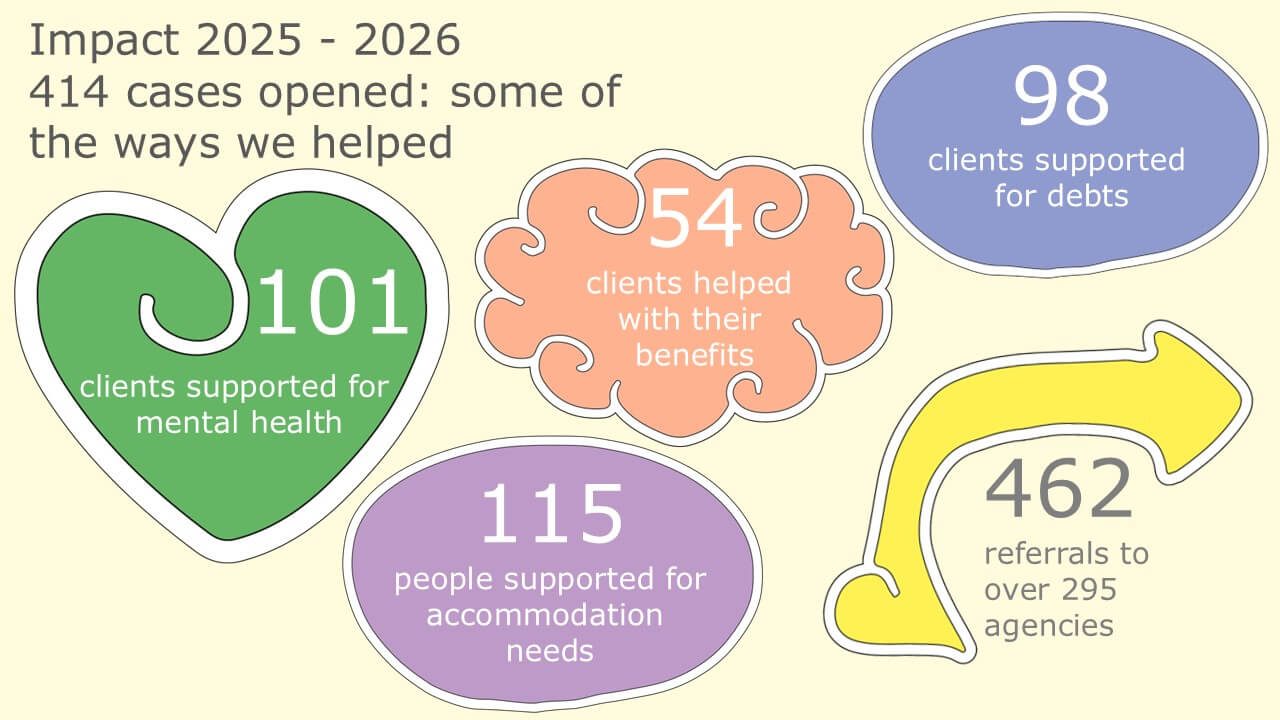
We believe that we are needed now more than ever. Each day, we are seeing increasing numbers of homelessness, along with intergenerational poverty, mental health needs, domestic abuse, substance use, training and employment needs, and basic access to online forms.
Punishment alone is not enough
Punishment alone cannot resolve the underlying problems that may contribute to someone repeatedly coming into contact with the justice system. We all need to work together to get people the support they need, whether they are defendants or victims.
Steve Parker, CEO, CASS+
People need help
We can make a very real difference by helping someone understand court paperwork, access financial advice, address accommodation problems or find appropriate mental health support.
No excuses
This is not about excusing criminal behaviour or suggesting that poverty removes personal responsibility. Ultimately, we want to use our knowledge and experience to help others understand the issues.
Being poor is not an excuse for criminality. But, from our experience, the catalyst for court could be removed if people could receive more support upstream, before they end up in crisis at court.
Steve Parker, CEO, CASS+
Justice must recognise the reality of poverty
The courts of Devon and Cornwall offer a window into the challenges facing some of the region’s most vulnerable people. For instance, behind an unpaid fine or a theft may be a household in debt and a family struggling to survive. We’re often looking at years of family instability, debt or unmet support needs.
Poverty is not always visible in a courtroom
Poverty is not always visible in a courtroom, and it is not always recorded as part of the legal proceedings. However, the effects of poverty are very often there.
We look at the person and not the offence
If we want a justice system that works effectively for everyone, we must look beyond the offence – we must see the person. Most importantly, we need to ask what happened before someone arrived at court, what support was available, and whether earlier intervention could have prevented their situation from reaching crisis point.
Ensuring that people are not left without a way forward
We can’t leave people without a way forward. This is why we are fully committed to remaining inside the courts in Exeter, Newton Abbot, Plymouth, Bodmin and Truro. Ultimately, without us, many people would be left without hope, with their needs unmet.
We understand
We listen to what people have been through. Then, we can use our experience to solve complicated situations and get people to the help they need. Furthermore, we will stay by their side throughout this time. This is how we steer people away from crime and towards a more settled life.
Support us
Please help us bring hope this winter. Your donation will enable us to give these families solutions in their time of crisis.
You can find out more about fundraising for CASS+ here.
Please make a donation here.